The Book of Pastoral Rule: The Complete Text
The Book of Pastoral Rule: The Complete Text
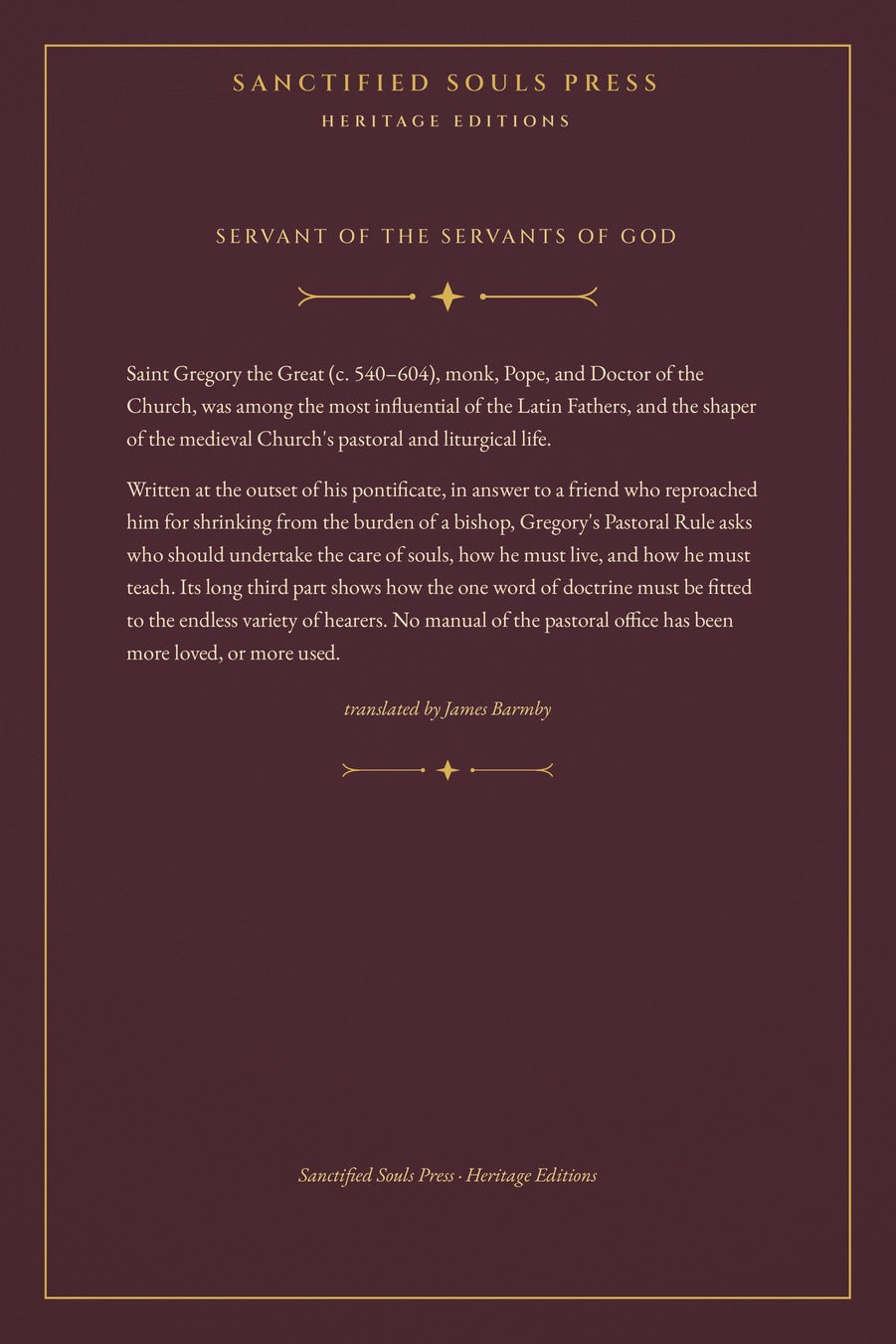
The one word of doctrine must be tempered to the endless variety of hearers.
Not yet released. This edition is set and in production. Write to the press and we will let you know the day it goes on sale.
On release, orders are placed and shipped through IngramSpark. This page is a catalogue listing.
About this edition
Saint Gregory the Great (c. 540–604), monk, then Pope, and Doctor of the Church, wrote The Book of Pastoral Rule at the very outset of his pontificate, in answer to a friend who had reproached him for trying to flee the burden of a bishop. It became the most influential treatise ever written on the office of a shepherd of souls.
Gregory divides the work into four parts: how one should come to the pastoral office; how he should live who has come to it; how he should teach those in his charge; and how he should daily return to himself, lest his very preaching lift him up. The third and longest part sets out, in forty chapters, how the one word of doctrine must be tempered to the endless variety of hearers, the poor and the rich, the joyful and the sad, the meek and the passionate, and the rest.
Carried into every quarter of the Latin Church, translated by King Alfred into English, and laid upon bishops at their consecration for a thousand years, it is given here complete in the public-domain English of the Nicene and Post-Nicene Fathers. Newly set on cream paper, for reading and keeping.
Details
- Saint Gregory the Great (c. 540–604), Pope, Father and Doctor of the Church
- Translated by James Barmby, in the Nicene and Post-Nicene Fathers
- Complete and unabridged: the four parts entire, with Gregory's dedicatory letter to Bishop John
- Sanctified Souls, Heritage Editions · Saint Gregory the Great, Book One
- Paperback and hardcover, 6 × 9, 174 pages, cream paper
Cover: jamb figures of bishop-saints on the south porch of Chartres Cathedral, a salted-paper print by Pierre-Émile-Joseph Pécarrère, c. 1850–52; The Metropolitan Museum of Art, New York. Public domain.