The Five Theological Orations and The Panegyrics
The Five Theological Orations and The Panegyrics
He did more than any other to establish the faith of the Trinity, and he did it with a poet's tongue.
Not yet released. This edition is set and in production. Write to the press and we will let you know the day it goes on sale.
On release, orders are placed and shipped through IngramSpark. This page is a catalogue listing.
About this edition
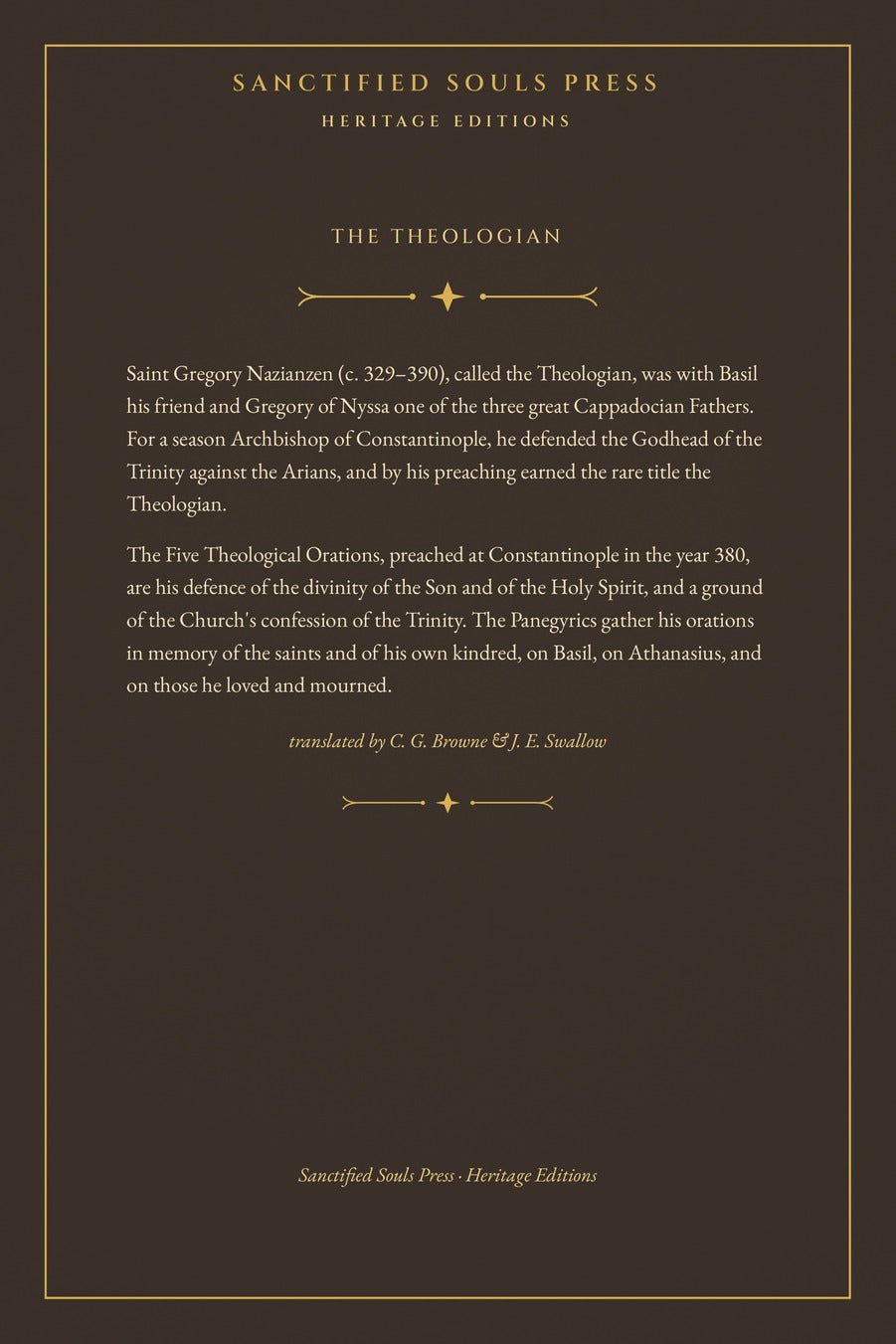
Saint Gregory Nazianzen (c. 329–390), the friend of Basil and one of the three great Cappadocian Fathers, is honoured in the East as the Theologian, a name given among the Fathers to him almost alone. For a brief and stormy season Archbishop of Constantinople, he did more than any other to establish the faith of the Trinity, and he did it with a poet's tongue.
The Five Theological Orations, preached at Constantinople in the year 380, are the summit of his teaching: on the right way to speak of God, on the being of God, on the Son, and on the Holy Spirit. From them the Church has drawn much of her language for the mystery of the Trinity. The Panegyrics are his orations of praise and of mourning, spoken over his brother and sister, over his own father, and over the two great champions of the faith whom he loved, Athanasius and Basil.
This Sanctified Souls Press edition gives all ten orations complete, in the public-domain English of the Nicene and Post-Nicene Fathers. Newly set on cream paper, for reading and keeping.
Details
- Saint Gregory Nazianzen (c. 329–390), the Theologian, Archbishop of Constantinople, Father and Doctor of the Church
- Translated by Charles Gordon Browne and James Edward Swallow, in the Nicene and Post-Nicene Fathers, 1894
- Ten orations complete: the Five Theological Orations, and five Panegyrics, on his brother Caesarius, his sister Gorgonia, his father, Saint Athanasius, and Saint Basil
- Sanctified Souls, Heritage Editions · Saint Gregory Nazianzen
- Paperback and hardcover, 6 × 9, 250 pages, cream paper
Cover: Saint Gregory Nazianzen, a line engraving by Francesco Bartolozzi (Italian, 1727–1815) after Domenico Zampieri, called Domenichino. Public domain.